






2009 BMW 7-Series
Prices: $80,300-$84,200
The BMW 7-Series sedan long has been the sportiest big luxury sedan in
its segment. The last all-new 7-Series arrived for 2002 with
controversial styling with its bulbous trunk lid, but it still was a
splendid "driver's car" and styling was revised a bit for 2006.
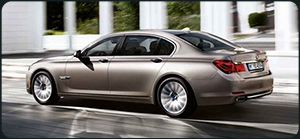
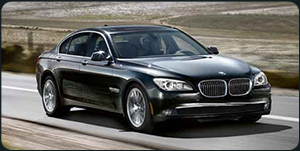
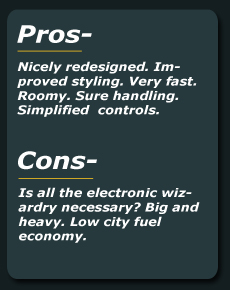
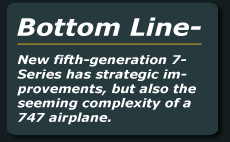
The new fifth-generation BMW 7-Series looks better than its
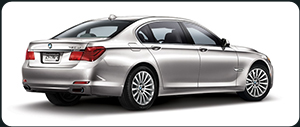
predecessor, although more conventional. This 2009 model has a wider
grille in the low front end, new headlights and a completely redone
rear with no unusual trunk lid and more regular-looking taillights. The
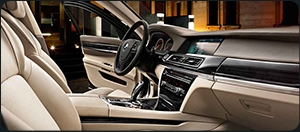
interior also has been improved, with simplified controls.
There's a total revamp of the overly complicated, widely disliked and
criticized iDrive control system with its many "menus" and settings for
climate, audio and navigation functions.
A new twin-turbocharged 4.4-liter V-8 has impressive torque and 400
horsepower--up 40 from the previous 4.8-liter V-8.
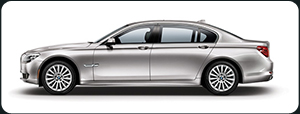
The new car comes in standard-wheelbase (120.9-inch) 750i form for
$80,300 or in longer-wheelbase (126.4-inch) 750Li form for $84,200.
Both wheelbases are about three inches longer for 2009.
The 750Li has its own roofline to provide more rear head room, besides
to help maintain the car's proportions to avoid making it look like a
stretched version of the shorter wheelbase 750i.
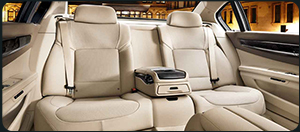
The 750i, which I tested, is exceptionally roomy in its own right,
especially in the rear-- although the center of the back seat is too
stiff for comfort. There's a standard four-zone climate control, which
provides, with a rear control panel, individual left/right control of
temperature and air volume in the back, just as in the front.
While the 750Li is roomier, there's really no need for it unless you
want some sort of limousine substitute. To that end, the the
long-wheelbase version has electronically controlled self-leveling air
springs that compensate for loads carried in the rear seat and trunk,
maintaining normal vehicle height, even when loaded with passengers and
luggage.
The 7-Series V-12 engine with its 438 horsepower is gone, but it isn't
needed because the new V-8 provides more torque (450 lb-ft. vs. 444
lb-ft.) and feels as if it has endless power. It moves this large,
4,564-4,640-pound sedan from 0-60 mph in 5.2 seconds and lets it touch
150 mph. The car is refined and quiet, and thus deceptively fast.
Power flows through a smooth, seamless six-speed automatic
transmission, with a manual-shift feature. It automatically downshifts
by up to four gears as quickly as if it were shifting down only one
gear. The transmission selector, incidentally, has been moved from the
steering column to the center console.
However, the rival Mercedes S-Class has a seven-speed automatic and the
Lexus LS has an eight speed automatic, thus trumping the 7-Series
automatic.
Interestingly, the new transmission automatically slips into Park mode
when the engine is shut off via the start/stop button when the
transmission is in Drive or Neutral. You also can put the car in Park
mode by pressing a button atop the gear selector. The emergency brake
is set or released via a console button.
Estimated fuel economy for such a big, heavy, fast car is what might be
expected-- an estimated 15 mpg in the city and 22 on highways for the
standard version and 14 and 22 for the long-wheelbase model. Premium
fuel is recommended, and there's a $1,000 gas-guzzler tax.
The weight is felt during fast acceleration on expressway on-ramps. But
the car's new suspension system helps keep it on the rails, allowing
remarkably good handling for such a hefty car.
Handling is helped by BMW's Driving Dynamics Control system, which
tailors vehicle characteristics at the touch of a button to different
drivers and such things as different driver moods and driving
conditions.
That system lets a driver choose between settings
for shock-absorber firmness, transmission shift characteristics,
engine-throttle response, transmission shift characteristics,
power-steering assist and Dynamic Stability Control mode (a stability
and traction-control system). There are Comfort, Normal, Sport and
Sport Plus settings.
The traction-and-stability Dynamic Stability Control system switches to
its Dynamic Traction Control setting for reduced traction intervention
which BMW says is "more suitable for track-style driving" or, more
practically, for improved start-up on snowy roads. I left the car in
its Normal setting most of the time because it's the best all-around
choice.
Whatever happened to the days when good handling, nice-riding cars were
simpler and didn't need all this adjustable stuff? Granted, if rivals
such as Mercedes-Benz high-line autos are loaded with high-tech
features, BMW feels it must also offer--if not outdo--competitors with
its own high-tech stuff.
Also assisting handling for the new 7-Series is an optional Active
Steering system, which assists low-speed maneuvers and high-speed
cornering. It lets rear wheels turn several degrees in the opposite
direction from the front wheels at lower speeds for better
maneuverability and in the same direction as the fronts for better
responsiveness on, say, winding roads.
A Japanese producer of fairly low-cost cars offered a similar, largely
ignored, feature years ago.
The new BMW remains a "driver's" car. Steering is quick, suitably
rather firm at higher speeds and nicely weighted The ride is supple,
and handling is sharp. The brakes are powerful, controlled by a pedal
that is a little touchy but has a linear action.
Hard chargers should opt for the $4,900 Sport Package with its active
roll stabilization system, 19-inch wheels and integral Active Steering.
Those with the resources can get the new 7-Series sedan with options
such as Active Cruise Control, Lane Departure Warning, Active Blind
Spot Detection, Head-up Display, High-Beam Assistant, Night Vision with
new pedestrian detection and Side-View and Back-up Cameras.
All those extras are either new to BMW or new to the 7-Series.
The really good news is the new version of BMW's distracting iDrive
system, which forced a driver to interact with it for anything other
than a few things including simple audio adjustments.
The redone iDrive allows much easier use of audio and navigation
settings, displayed on a large 10-2-inch screen atop the center stack
near the dashboard. "Menus" on the navigation screen flow intuitively
from one to another for quick, easy access to stereo and navigation
controls. Redundant shortcut buttons are put around the iDrive main
controller wheel, which generally acts like a computer mouse.. Climate
controls are taken from iDrive and housed in a separate center stack
area.
Large, easily gripped door handles make it easy to enter the
church-quiet, sumptuously finished interior. And long, chromed interior
door handles make it easy to get out. If you don't close the doors
firmly enough, an optional "soft-close" feature in a $1,700 Convenience
Package clicks them tightly shut.
Front seats are supportive for spirited driving, and rear seats are
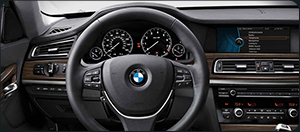
well-shaped. Gauges can be quickly read, and vision is good. The large
outside mirrors fold in to prevent parking-lot damage.
There are plenty of storage areas, with pockets in all doors and a
front console bin with twin covers The large center rear armrest has
width-adjustable cupholders and a small covered bin. Rear windows roll
all the way down.
The trunk is huge, with a low, wide opening. An automatic trunk lid
opener-closer is part of the Convenience Package.
The hood glides open on twin struts, revealing a big engine cover that
says "Twin Turbo" It also could rightfully say "Driving excitement,"
although those unfamiliar with BMWs might not expect that from such a
big, heavy luxury car.