






2011 Chrysler 200 Sedan
Chrysler quickly offers surprisingly good new 200 mid-size sedan for
2011
Prices: $19,245-$23,745
Chrysler performed a major
miracle in transforming its so-so Sebring mid-size front-drive sedan
into the far superior Chrysler 200 model in only about a year. Such a
project usually takes much longer, but faltering Chrysler had to rush
things.
Many critics are surprised, and some feel it shows that Chrysler
promises to be far more competitive under its new Fiat control.
The Sebring name is gone, replaced by the “200”
name. The 2011 200 logically fits beneath the name given the improved
top-line 2011 Chrysler 300.
There are three 200 trim levels. They are the base $19,245 LX,
mid-range $21,245 Touring and top-line $23,745 Limited, which I tested.
The LX has air conditioning, four-speaker AM/FM/CD/MP3 sound system,
cruise control, 17-inch wheels, keyless entry, power windows and heated
power mirrors—but just a four-speed automatic
transmission.
The Touring adds a six-speed automatic, power driver’s seat,
automatic temperature control, six-speaker sound system, alloy wheels,
automatic headlights and tilt leather-covered wheel with auxiliary
controls.
The top dog Limited throws in leather-covered seats, power heated
driver’s seat, upgraded sound system, hands-free phone and
wider tires on 18-inch wheels.
Safety features for all versions include a bunch of air bags, stability
and traction control and anti-lock brakes with a brake-assist
feature.
What’s new for the 200? Just about everything, it seems.
Nearly every system in the car is new or has been upgraded.
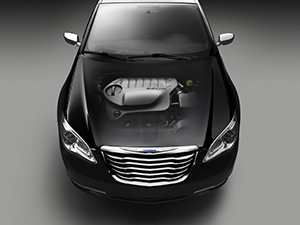
Optional is a new, strong 3.6-liter, 283 horsepower
V-6—although the car’s carryover base 2.4-liter,
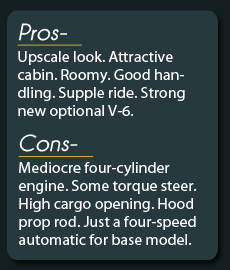
173-horsepower four-cylinder engine is mediocre.
While the four-cylinder must work with an old-fashioned four-speed
automatic in the base LX, the V-6 comes only with a modern six-speed
automatic with an easily used manual-shift feature. The six-speed is
standard in the Touring and Limited with the $1,795 V-6 and
works best with that engine.
The four-cylinder is fine in town, but lacks punch for quick merging or
passing on highways, although steady highway cruising is OK. The car is
fairly heavy at 3,389 pounds with the
four-cylinder—or 3,559 pounds with the V-6.
The V-6 provides strong acceleration, but some torque steer when the
accelerator is floored. My test 200 Limited was brand new and nicely
assembled. But the car emitted a curious droning sound when
accelerating moderately from a stop. The sound might have come from a
vibration not caught when the car was being prepared after delivery to
a dealer.
Estimated fuel economy with the V-6 is 19 mpg in the city and 29 on
highways. The four-cylinder delivers a few more miles per gallon.
Neither engine requires premium fuel, and the tank capacity is 16.9
gallons.
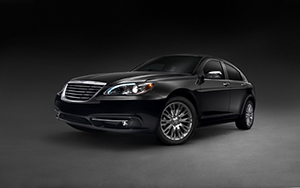
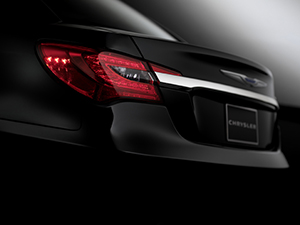
Although stuck with the Sebring’s high roofline, the 200
looks sharper, with new sheet metal that provides fresh front and rear
styling. The front is cleaner than the Sebring’s.
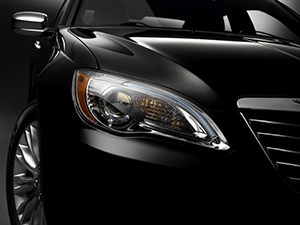
It’s ‘sculpted,” with such items as new
fenders, hood and projector headlights. The aggressive-looking new
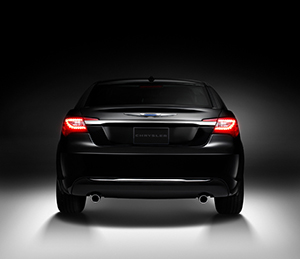
grille has Chryslers new winged badge, and the new trunk lid and
taillights are new.
The 200 has good road presence with its slightly lowered height and
wider front and rear tracks. The nicely integrated dual exhaust outlets
on my test Limited model looked sexy.
The Sebring’s low-brow interior—long a sore
point—has been replaced by a new, far
more attractive cabin, with improved materials. It’s much
quieter, thanks to such items as an acoustic glass windshield,
laminated side glass and sound-absorption material in strategic spots
throughout the car. There are soft-touch armrests, and a new one-piece
dashboard prevents squeak-causing seams.
Gauges can be quickly read, and controls are sensibly placed for easy
use. There are a fair number of storage areas.
The Sebring was roomy. So is the 200, although 6-footers with long legs
will want more knee space behind a driver. Also, the center of the rear
seat is too stiff for comfort. No problem up front, though, in my test
car’s redesigned supportive seats.
The retuned steering is firm, but precise. The 200 is no sports sedan,
but handling is secure—thanks partly to major suspension
upgrades. Spring rates and and the size of the front and rear
stabilizer bar diameters were increased, reducing body sway and
increasing steering sensitivity. The ride is supple, and the brake
pedal provides a progressive action for consistently smooth stops.
The nicely shaped, fairly large trunk has a high opening, but its lid
lacks an interior pull-down feature. Thick rear seatbacks flip forward
to increase the cargo area and sit nearly flat.
The hood is quite heavy and only held up with an awkward manual prop
rod. Fluid filler areas can be easily reached.
The 200 is in one of the toughest car markets, but it has a much better
chance of grabbing buyers than the old Sebring did.