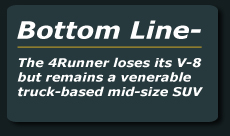







2010 Toyota 4Runner
Prices: $27,500-$39,800
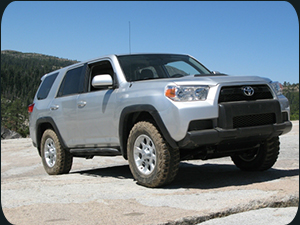
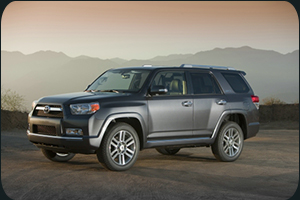
The fifth-generation Toyota 4Runner mid-size SUV retains its awkward
name, but is longer, wider and taller and more refined, with styling
that is more muscular, but blockier. There’s no loss of
impressive off-road abilities, especially with the Trail version, which
reminds me of the original Reagan-era 4Runner.
While many have flocked to car-based crossover vehicles, the 4Runner
remains a genuine body-on-frame SUV, aimed a lot at outdoor types.
Still, the 4Runnner has a surprisingly relaxed ride on roads for an
SUV—although its live rear axle results in a side-to-side
toss on some rough
roads.
The 4.7-liter V-8 with its 260 horsepower has been replaced by a
4-liter V-6 that produces 270 horsepower. The V-6 is largely a
carryover, but has added variable valve timing for intake and exhaust
and a higher compression ratio.
The V-6 provides quick acceleration. But, while featuring more power
than the V-8, its torque rating is down 28 pound-feet to 278
pound-feet. And maximum towing capacity also has fallen a little.
Base models have a new 2.7-liter four-cylinder engine with 157
horsepower and 178 pound-feet of torque. The four-cylinder is fine in
town, but must fight too much of the 4Runner’s
4,295-4,805-pound weight to be provide anything but leisurely
acceleration.
Moreover, the “four” doesn’t offer much
of a fuel economy advantage, delivering an estimated 18 mpg in the city
and 23 on highways, compared to 17 mpg city and 22-23 highway for the
V-6.
The base 4Runner has a four-speed automatic transmission, while V-6
models have a more advanced five-speed automatic with an easily used
manual-shift feature..
List prices for the 4Runner are rather high.The base SR5 version goes
from $27,500 to
$30,915, while the Trail model is $35,700. The top-line Limited costs
$37,765 to $39,800.
The base four-cylinder model comes with rear-wheel drive, while most
other 4Runners are offered with rear- or four-wheel drive.
Four-wheel-drive models have a low range, downhill assist and an
off-road traction program.
Even the base SR5 has much standard equipment, including a power
driver’s seat, air conditioning, cruise control, keyless
entry, power windows and heated power mirrors that are commendably
large.
Safety features include stability control with traction control,
anti-lock brakes and a bunch of air bags.
The SR5 V6 adds the six-cylinder and five-speed automatic that lets the
engine loaf at 2,000 rpm at 70 mph, while the Trail V6 adds an AM/FM/CD
with eight speakers and power front sunroof. The Trail also has
specific off-road items including a rear differential lock, electronic
off-roading aids such as crawl control and multi-terrain select that
tunes the throttle and traction control to various
surfaces—not to mention special wheels and tires.
Opt for the Limited V6 and added are items including leather-covered
seats, 15 speakers, a“sport alternative
suspension,” power heated driver’s seat,
and a “Kinetic Dynamic Suspension System” that
disconnects stabilizer bars for extended wheel travel and a softer ride.
A variety of options includes the $525 backup camera in my SR5
four-wheel drive model.
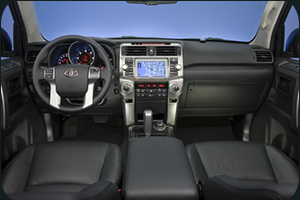
The interior of the V-6 version is very quiet. There are easily
reached, high-mounted controls, with especially large climate and sound
system controls. However, the ignition switch is buried behind the
steering wheel. Seats are supportive, and occupants sit high, although
extra effort is needed to get in.
There’s plenty of room for four to five tall adults, but the
$1,015 third-row seat available for the Limited V6 is just for two kids.
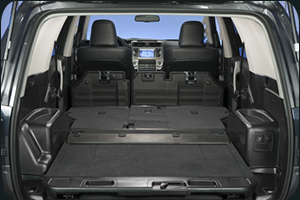
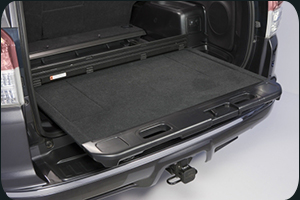
The large cargo area has a high-but-wide opening and rear seats flip
forward to increase the cargo area. The power rear tailgate window,
which replaces flip-up glass, is a nice touch.
Steering is quick and nicely weighted, although some may feel
it’s a bit heavy. Handling is pretty good, although the
4Runner’s weight can be felt during quick maneuvers While
physically larger, the new 4Runner can be easily parked. The firm brake
pedal has a linear action for smooth stops.
The hood glides open on twin struts, so there’s no need to
fool with an awkward hood prop rod.
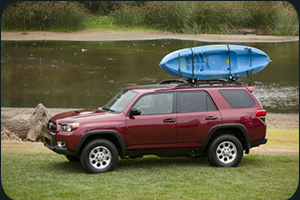
Mid-size SUVs aren’t as popular as they once were, but the
4Runner offers plenty of active lifestyle usability.