






2010 Porsche Panamera
Prices: $89,800-$132,600
Many Porsche fans still feel this revered German automaker should build
only sports cars with a rear-mounted engine. But it’s built
many excellent front-engine cars—notably the 1980s-90s fast,
luxurious 928 coupe. And it really broke its mold by introducing the
Cayenne sport-utility vehicle in 2003.
Porsche purists felt a Porsche SUV was outrageous, but Porsche tired of
seeing sports cars such as its iconic 911 sitting in garages next to
high-line SUVs from rivals. As it turned out, the Cayenne has been one
of Porsche’s hottest-ever sellers.
Time will tell if the new Panamera—first all-new Porsche in
seven years—will be as successful. But a fast, luxurious
Porsche sedan long has been overdue. Several one-of-a-kind Porsche
four-door models have occasionally cropped up over the years, although
they looked like rather distorted versions of the 911 and soon were
forgotten.
“With the Panamera, our engineers combined
Porsche’s sporting DNA with the spaciousness and comfort of a
luxurious sedan,” said Wolfgang Durheimer,
Porsche’s executive vice president of research and
development.
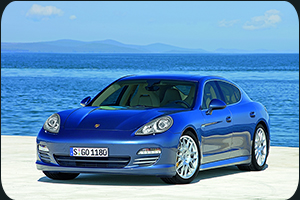
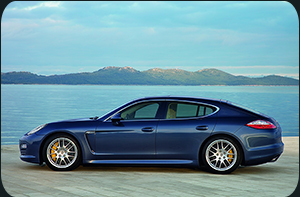
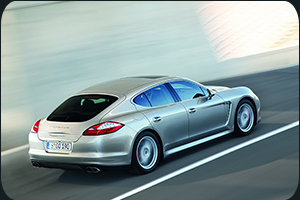
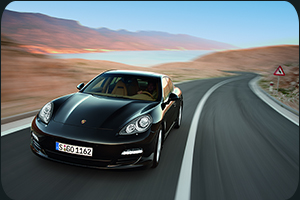
The Panamera has 911 styling cues and a coupe’s silhouette.
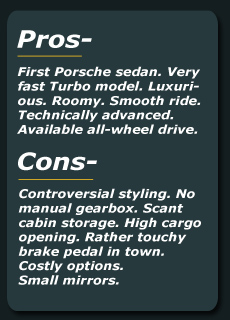
Some feel it looks controversial from the side, but most agree that it
looks good from other angles and has tremendous road presence.
The Panamera’s name is derived the long, grueling
1950s Carrera Panamericana road race in Mexico, where Porsche victories
helped put its name on the map.
The Panamera comes as a four-door hatchback with four separate seats in
three trim levels. The entry model is the $89,800
rear-wheel-drive Panamera S, which has a normally aspirated 400
horsepower V-8. It’s followed by the all-wheel-drive (AWD)
Panamera 4S, which has the same engine. The top version is the $132,600
Panamera Turbo, which also has AWD and is scary fast with its
twin-turbocharged 500-horsepower V-8.
In true Porsche tradition, options can considerably raise the price. A
Panamera S I tested had extras that bumped its list price to
$109,160. They included $3,655 leather upholstery, $2,950 sport exhaust
system, $1,990 adaptive air suspension and a $219 heated steering wheel.
A Turbo version had options that bumped its price to $145,715. I could
have done without them, although the heated steering wheel
would be welcome during Chicago winters and its $2,490 adaptive cruise
control system can help prevent rear-end collisions.
The Turbo does 0-60 mph in 4 seconds and is able to reach 188
mph. I found even with the S that a 65-75 mph passing
maneuver turned into a 65-85 mph maneuver before I realized the car was
moving so fast.
The 400-horsepower Panamera models are plenty fast, with the S doing
0-60 mph in 5.2 seconds and the 4S hitting 60 in 4.8 seconds. Both can
reach 175 mph.
The Panamera is so quiet, smooth and docile that a nonsuspecting driver
would have no idea what a rocket ship it is. In fact, the car is meant
to be driven daily.
Wide-opening doors with large handles allow easy entry to front and
rear seats. The power hatch opens to reveal a big cargo area, which can
be made considerably more spacious by flipping the twin rear seatbacks
forward. The wide cargo opening is high, but the folded seatbacks sit
flat—allowing a whopping 44.6 cubic feet of cargo room.
Estimated fuel economy for the Panamera is pretty good, considering its
performance and the fact that it weights 3,968 to 4,343-pounds. The S
and 4S deliver 16 mpg in the city and 24 on highways, while the Turbo
provides 15 and 23. No version has a gas-guzzler tax. And
don’t bet against a more fuel-stingy hybrid version of the
Panamera being introduced in the not-distant future.
Power flows through Porsche’s innovative, ultra-efficient
“PDK” seven-speed double-clutch automatic gearbox,
which also works in manual mode. The steering wheel manual-shift
controls are somewhat awkward to use but allow lightning-quick shifts.
The Panamera is the first premium car with an automatically shifting
double-clutch transmission that has an engine start/stop system that
saves fuel by turning the engine off when it isn’t needed, as
when sitting at a stop light.
No regular manual transmission is offered here, although a conventional
six-speed manual is available in Europe. The Pamamera has so much power
and torque that a conventional manual gearbox really isn’t
necessary, at least for U.S. driving. But what the heck--this is a
Porsche, isn’t it?
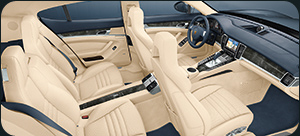
The Panamera drives like a big four-seat sports car, with the front and
rear seats separated by a long console that extends into the rear
seating area.
The new Porsche delivers the kind of ride that is especially
comfortable on long trips. The adaptive air spring suspension--standard
on the Turbo and optional for the other versions--helps provide an
especially smooth ride.
All models handle adroitly, and even the Turbo has remarkably flat
cornering, although it’s the heaviest Panamera at 4,343
pounds. An optional Dynamic Chassis Control system with two active
anti-roll bars further enhance driving dynamics and comfort. The base
rear-drive 400-horsepower Panamera feels a little lighter on its feet
because it weighs less, at 3,968 pounds, than the AWD versions.
The Panamera’s precise, quick steering has good road feel,
but brakes on the S were rather touchy during low-speed suburban
driving. That fault vanished at higher speeds on on highways. In any
case, Porsches long have been known for exceptional braking, and the
Panamera’s brakes are quite powerful.
There’s generous room for four tall adults,
although the supportive front seats have cushions that may seem narrow
for heavier occupants.
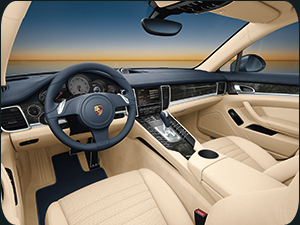
The quiet interior of the beautifully built car is gorgeous. What
appears to be an excessive number of center-console control buttons are
easy for drivers to use because they’re laid out in a logical
manner. Porsche spokesman Gary Fong said the buttons “are
better than drilling down through menus that force a driver to look at
a center LCD display”.
It took Porsche a long time to introduce a sporty sedan, but the
Panamera shows the wait has been worth it.