






2010 Ford Mustang
Prices: $20,995-$35,995
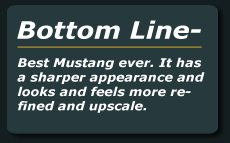
Ford has wisely used the time to make the 2010 Mustang considerably
better than the retro-styled last-generation model, which arrived for
2005. The new model looks better, is built tighter and has a much more
upscale interior. Importantly, the car remains a blast to drive,
especially with the available V-8.
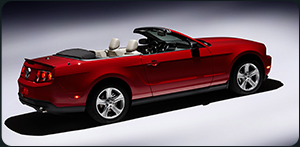
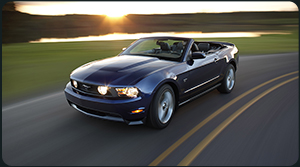
The Mustang comes as a coupe or convertible and as a coupe with a glass
roof, which is the next best thing to driving a convertible.
The new Mustang has last year's engines, although that's no bad thing.
The base model has a 4-liter, 210-horsepower V-6 that provides lively
acceleration, and the GT model features the 4.6-liter 315-horsepower
V-8 found in the 2009 Bullitt version of the standard
300-horsepower GT V-8.
While butter-smooth, the V-8 needs lots of revs for the best
performance, with third gear best for the fastest 65-75 mph passing on
highways. However, the car loafs at 2,000 rpm at 65 mph, even with the
numerically higher 3.73 final drive in my test car--a ratio meant for
quicker acceleration. (Figure on 0-60 mph in 5.1 seconds with the V-8
and in 6.9 seconds with the V-6.)
Prices for the new front-engine, rear-drive coupe range from $20,995
for the entry V-6 model to $27,995 for the GT V-8--with the more
upscale GT Premium coupe I tested at $30,995.
Add $1,995 if you get the fixed panoramic glass roof panel option.
The V-6 convertible costs $25,995, or $28,995 in Premium form. The GT
V-8 convertible is $32,995, or $35,995 in Premium trim.
Both the V-6 and V-8 engines come with a five-speed manual or
five-speed automatic transmission. The manual works with a rather
stiff, long-throw clutch. However, the shifter works
beautifully with the V-8, and pedals are conveniently placed.
Fuel economy is decent for a fast, sporty car. The V-6 with the manual
gets an estimated 18 mpg in the city and 26 on highways. The figures
are 16 and 24 with the automatic. The GT also delivers 16 and 24, but
with the manual gearbox. With the automatic, they're 17 and 23.
Only regular-grade gasoline is needed, although Ford says premium fuel
will improve mid-range torque, which is used a lot in typical driving.
A capless fuel system does away with a gas cap.
The Mustang is nearly the same size as the 2009 model but
it's smaller and several hundred pounds lighter than its main
rivals--the new Chevrolet Camaro and Dodge Challenger. The lighter
weight helped the GT edge out the more-powerful Camaro SS and
Challenger R/T in a Car and Driver magazine comparison test.
Not that most buyers of any of those cars will care. There's terrific
loyalty among pony car fans. Thus, it's doubtful that many potential
buyers of the new Mustang--the original pony car--will consider the
Camaro or Challenger.
More than 9 million customers have made the Mustang one of America's
automotive icons. Ford says it received Mustang customer input for the
2010 Mustang "everywhere from race tracks to Main Streets in cities
throughout the U.S."
Extensive consumer research did little if anything to help Ford Motor's
ill-fated 1950s Edsel, but it sure helped make the new Mustang
much-improved.
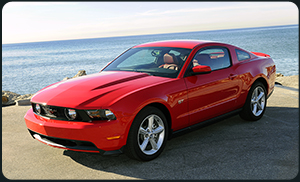
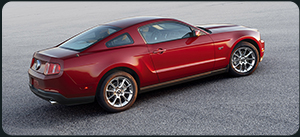
The new car has a muscular, sculptured exterior with a custom
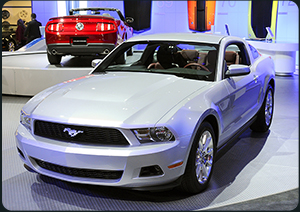
look. It resembles the 2009 model, but has a more aggressive front
fascia with a markedly forward-leaning grille punctuated with the first
new Mustang emblem since the car's debuted in the spring of 1964.
Body panels, except the roof, are new and a "power dome" hood
adds to the muscular appearance. Nifty touches include new sequential
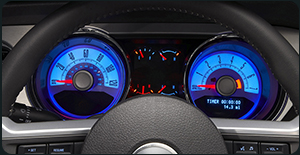
turn signals seen on the late-1960s Mercury Cougar. Ford's MyColor
feature lets a driver choose from many illumination colors for gauges,
ambient cabin lighting and cool illumined sill plates.
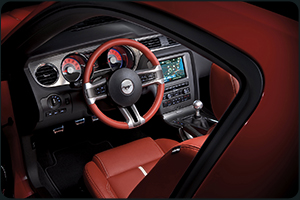
Ford found that many Mustang owners wanted an improved interior. So the
cockpit has upgraded materials, a soft-touch dashboard and far more
craftsmanship. It's quiet in there, although Ford has cleverly
installed an induction sound tube that pipes the right amount of engine
noise into the interior during fast acceleration.
Front seats should be more supportive, but there's room for four
6-footers--if front occupants move their seats up more than they
normally would. Rear seats are nicely shaped, but there's little room
to spare back there for adults. Getting in and out of the rear is a
hassle.
Long, heavy doors can make entry/exit a bother in tight spots, although
large outside/inside door handles can be easily grasped.
The moderately large trunk has a high opening that won't help fast
unloading at airport departure terminals. But its lid, which has an
inner cover, goes up and down quickly on twin struts. Split rear
seatbacks flip forward to enlarge the cargo area and sit fairly flat.
But the pass-through opening between the trunk and rear seat
is only moderately large.
Wheels are slightly larger, moving up to 17 and 19 inches, and chassis
changes have been made for a smoother ride and improved body control.
The Mustang still lacks an independent rear suspension, which is a
prime feature of the new Camaro. But the rear suspension with
its old-style solid rear axle is so well designed that only serious
highway bumps can be felt and the ride only deteriorates on really
rough pavement. Also, a solid rear axle holds the car's cost down.
Electronic stability control is standard, as are all-speed traction
control and anti-lock brakes. Also standard are dual-stage front air
bags and side air bags.
Many car buffs will want the $1,495 Track Pack sport suspension with
its 19-inch wheels, suspension parts from the mighty 500-horsepower
2009 Shelby Mustang GT500, summer performance tires,.3.73 final drive
ratio for faster acceleration, limited-slip differential and
performance brake pads.
That modified suspension, stickier tires and a hefty strut tower
brace help Mustang handling because the car is nose-heavy,
despite the V-8 being set back to help weight distribution.
One need not be a performance car buff to appreciate Ford's Sync
"infotainment" system, which recognizes voice commands--and its iPod
and Bluetooth phone integration.
Everyone should appreciate the way the car drives. It has sure handling
and a supple ride. Steering--rarely a Mustang strong point--is quick,
but should have better overall feel. The brake pedal makes it easy to
stop smoothly.
The view over the power dome hood is impressive. All-around driver
visibility is good, and the speedometer and tachometer can be easily
read. Secondary gauges between those two instruments are much smaller,
but nicely positioned.. There's a mixture of small and large audio and
climate system controls The power outside mirrors are
adequately sized, although their control has a rather awkward action.
The console's dual cupholders are nicely located, and driver power
window controls on the door won't let you mistakenly lower a rear
window instead of a front one. The pull-up hand brake is put out of the
way by the driver's seat. Thin door storage pockets don't hold much.
The heavy hood is held open by an old-fashioned prop rod. But fluid
filler areas are easily reached, and the engine isn't hidden beneath an
unsightly plastic cover.
It's clear that Ford spent lots of time and effort making the new
Mustang significantly better than its predecessor. The automaker says
it designed and engineered the new model "to be the next classic
Mustang that everyone talks about for years and years."
That might be right.